
The Lost Vinyl of Olompali
This blog series was written as part of the Historic Plastics Digital Collection, and brings together a variety of experts and enthusiasts to showcase the many ways in which the wide world of plastic interacts with, and informs, our daily life. You can learn more by visiting Hannon Library’s Southern Oregon Digital Archives.
by E. Breck Parkman
In the predawn hours of February 2, 1969, a fire destroyed the twenty-six room Burdell Mansion at what is now Olompali State Historic Park, in Marin County, California. At the time, the local press called the white stucco Mansion the “Whitehouse of Hippiedom” as it was home to the “Chosen Family,” an intentional community with close associations to the iconic Sixties band, the Grateful Dead. In 1966, a year before the commune moved in, the members of the Grateful Dead had themselves lived at Rancho Olompali. The band members continued to visit the ranch during the two years that the Chosen Family lived there.
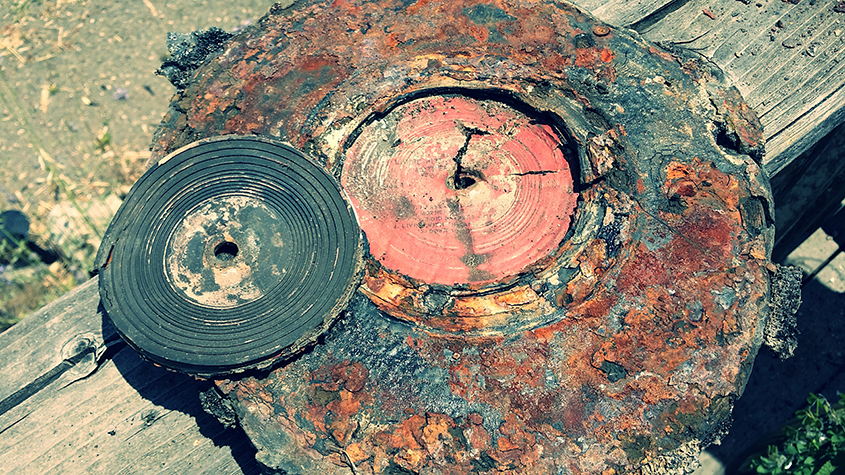
When the Burdell Mansion burned, all the communard’s possessions were damaged. The fire left behind the wreckage of their community: furniture, clothes, and the accompanying detritus of everyday life were scorched and melted by the fire and heat before their abandonment to the elements as the community fragmented with the loss of their home. Years later, State Archaeologist Breck Parkman salvaged what remained of these possessions from the fire debris. The items found included a wide range of artifacts, including toothbrushes and tubes of toothpaste, hair combs, leather shoes, jewelry, ceramic dishes and glass beverage bottles, billiard balls, monopoly and chess pieces, reel-to-reel tapes, vinyl records, and almost everything else one might expect in a house where several dozen people were living.
Of all the artifacts discovered, the most significant were the vinyl records. A total of ninety-four records were found, including seventy-five that have been identified. All but two of the records are 33 1/3 rpm discs. The other two are 45s (French language instructional recordings). The discography represented by this record collection is wide-ranging, including rock, jazz, folk, country, pop, comedy, show tunes, classical, and educational recordings. The musical diversity found here testifies to the makeup of the commune, suggesting a diversity of personalities and a range of past histories, as one would expect of any such diverse group coming together for a common purpose. Most importantly, the records inform a discussion of cultural stereotypes, in this case, the one we know as the “hippie.” The range of musical genres represented by the records suggests that the stereotype is wrong, and that no two “hippies” were the same.
You can read more about the project in Parkman’s co-authored chapter “Vinyl Records in Archaeological Context: A Case Study from Northern California” (Liam Thomas Maloney and E. Breck Parkman), found in The Routledge Handbook of Archaeology and Plastics.
“A Burned Commune Offers Archaeologists a Window Into 1960s Counterculture” (JPR podcast, by Chelsea Rose, Published February 20, 2025)
“Underground History: Sonic Debris” (JPR story, by Chelsea Rose, Published April 28, 2025)
