This blog series was written as part of the Historic Plastics Digital Collection, and brings together a variety of experts and enthusiasts to showcase the many ways in which the wide world of plastic interacts with, and informs, our daily life. You can learn more by visiting Hannon Library’s Southern Oregon Digital Archives.
by Julia Huddleson
I recently ran across my grandmother’s celluloid button hook in a box of her sewing supplies. I started thinking about her life and all she experienced. Grandma Suzie was born in Nebraska in the late 1890s into a farming family. As the oldest child, she helped with household duties, including the care of her younger siblings. They left their farm in the early 1900s because of a severe drought and followed many of their friends and neighbors to California. They first came to Long Beach but eventually settled in the East Mojave Desert to homestead in hopes that they could resume their farming life.
Looking through family photographs, I was very excited to find one of my grandparents in about 1915 with Susie wearing button-up boots. Far from decorative fancy button up shoes with high heels, she wore no-nonsense functional buttoned shoes to do household chores on the farm. Her button hook clearly was a valuable tool that she kept long after she stopped wearing button up shoes.
Although button hooks were developed in the 1700s and the first button hook patents were issued in the 1870s, they weren’t widely used in Europe and the United States until the mid-1880s. In addition to fastening shoes, button hooks were used to button gloves, waistbands, bodices, spats, jackets, vests, and collars among other things. Collectors believe buttonhooks were first marketed to men for buttoning spats.
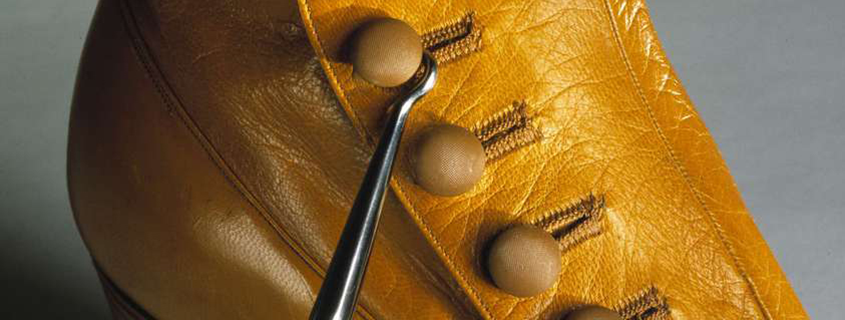
In the Victorian era, fashionable clothing and shoes were worn tightly against the body, and buttons held everything in place. The buttons were often closely spaced, which made it difficult to fasten without using a button hook. The hook was inserted in the buttonhole, hooked the button and pulled it through.
Hooks were made of various metals depending on their intended use. Hooks for boots typically had a steel shank for strength. Whereas for gloves, they could be smaller and made of other metals such as silver, gold, or brass. Handles were made of ivory, bone, silver, nickel-plated steel, pewter, wood, celluloid, or Bakelite. The first plastic button hook handles were made to mimic earlier materials like bone or ivory. If you look carefully at Grandma Susie’s hook, you can see the celluloid handle has striations reminiscent of bone or ivory handles that it emulates.
Button hooks could be decorative, and some were quite ornamental. Many were plain like Susie’s hook. Companies also gave them away as promotional items with the company name prominently displayed. Button hooks came in a variety of sizes and shapes. The main variation is in length and diameter of the hook, ranging in length from 1” to over 20”. However, hooks for shoes generally ranged from 7” to 12” and had a hook diameter of about 3/8ths-inch. They were small portable tools that could be carried around.
Suzie’s celluloid button hook is plain and undecorated. But it has special meaning to me because it is a connection to my grandmother as a young woman. You can see button hooks similar to Susie’s in SOULA’s Historic Plastics Digital Collection.

Celluloid button hook with striations in the celluloid to mimic bone handles
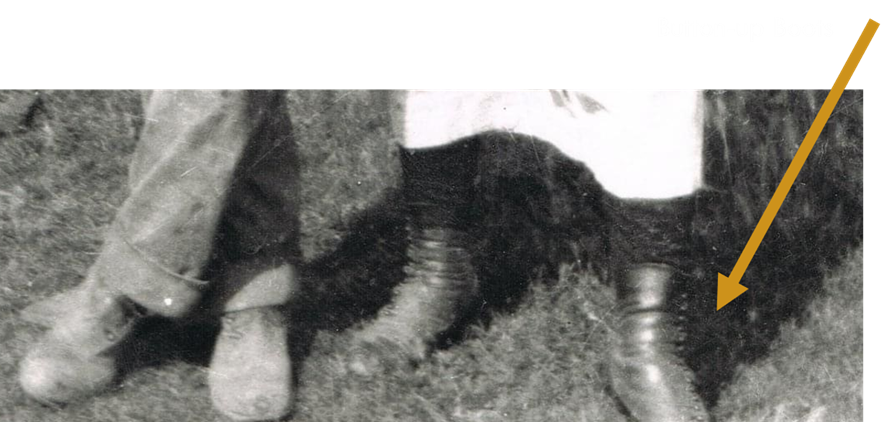
Susie’s button up boots
Featured image is by Birgit Brånvall, CC BY 3.0 no, https://commons.wikimedia.org/w/index.php?curid=29476283
Julia Huddleson is an archaeologist at the California Department of Transportation. She specializes in Post-Contact Archaeology and is the co-creator of the Historic Plastics Workshop with Kimberly Wooten.