Face with word "error" and zeroes and ones projected it. Photo by Jayson Hinrichsen on Unsplash

With the winter term coming up, I’m looking forward to teaching LIS 360 again. It’s a class that looks at how sexism, racism, and other forms of oppression are reinforced through the digital technologies we’ve come to depend on: commercial search engines, predictive AI, facial recognition software, social media platforms, and more. This time around, I’m excited to add a new book to our course readings, Algorithms of Resistance by media scholars Tiziano Bonini and Emiliano Treré (available as a free eBook from MIT Press).

The authors recognize the power of algorithms and corporate-controlled digital platforms to amplify injustice and exploitation. Their focus, however, is on the acts of everyday agency and resistance through which individual users and social movements appropriate the power of algorithms for their own purposes.

Bonini and Treré (2024) define algorithmic agency as a user’s capacity to “make the algorithms work to meet their own needs” (p. 19) or to “exercise power over the ‘outcome’ of an algorithm” (p. 20). The authors observe that people in marginalized positions (and their allies) may resist platform power by making use of the same algorithms that oppress them: “Algorithms, in fact, can also be the tool through which citizens, workers, artists, critical scholars and activists exercise their protest actions” (Bonini & Treré, 2024, p. 24).

Very often, these subversive acts are modest and unglamorous, what Bonini and Treré (2024) call “actions of microresistance” (p. 25). For example, drawing on fieldwork from media scholar Swati Singh, they provide an account of a courier working for an online food delivery service in Delhi, India. The courier resents that the platform’s algorithm offers him too few deliveries to make a profit. So, sometimes when he’s not receiving any orders, he uses a second cell phone to place an order for a restaurant nearby. Since he is the closest courier to that restaurant, the algorithm assigns him the order. He picks up the food and then, playing the role of the customer, he cancels the order and gets a refund from the platform. In this way, he acquires a free meal (Bonini & Treré, 2024, pp. 59–61).

Bonini and Treré (2024) also examine the activities of groups such as K-pop fans. Fans of BTS, for example, went to great lengths to boost the Spotify rankings of the boy band’s album Love Yourself: Answer in a scheme involving fake accounts, virtual private networks, and continuous streaming across multiple devices (pp. 115–116). In the political realm, K-pop fans have been “responsible for hijacking right-wing hashtags like #MAGA, #BlueLivesMatter, and #whitelivesmatter, flooding them with clips of K-pop groups, memes, and similar content to drown out racist and other offensive voices” (Bonini & Treré, 2024, p. 153).

In a class that talks so much about the ways in which algorithms act to oppress us, I’m glad to have found a text I can teach that concerns itself with the theory and practice of resistance to algorithmic control. I think Algorithms of Resistance will be a great addition to the class, and I look forward to discussing it with students in the winter.

Bonini, T., & Treré, E. (2024). Algorithms of resistance: The everyday fight against platform power. The MIT Press. https://doi.org/10.7551/mitpress/14329.001.0001


Tom Dodson is an associate professor and the web and discovery librarian at the Hannon Library. He is also the author of the short story collection No Use Pretending, winner of the Iowa Short Fiction Award 2023.

This blog series was written as part of the Historic Plastics Digital Collection, and brings together a variety of experts and enthusiasts to showcase the many ways in which the wide world of plastic interacts with, and informs, our daily life. You can learn more by visiting Hannon Library’s Southern Oregon Digital Archives.

by Julia Huddleson

I recently ran across my grandmother’s celluloid button hook in a box of her sewing supplies. I started thinking about her life and all she experienced. Grandma Suzie was born in Nebraska in the late 1890s into a farming family. As the oldest child, she helped with household duties, including the care of her younger siblings. They left their farm in the early 1900s because of a severe drought and followed many of their friends and neighbors to California. They first came to Long Beach but eventually settled in the East Mojave Desert to homestead in hopes that they could resume their farming life.

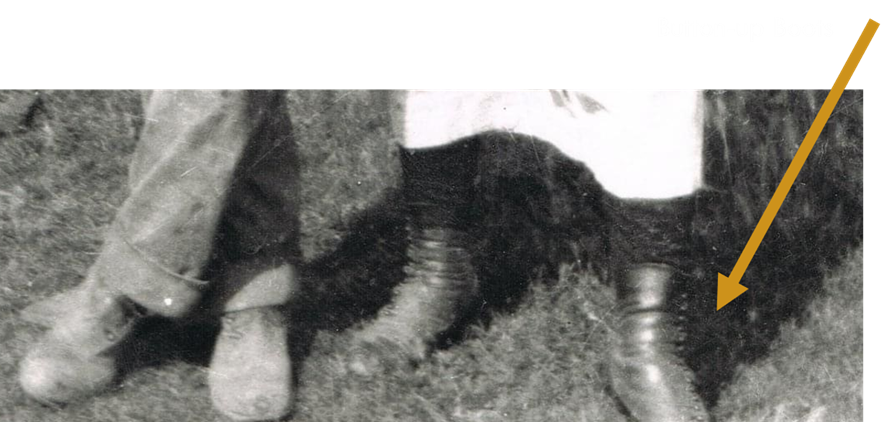
Looking through family photographs, I was very excited to find one of my grandparents in about 1915 with Susie wearing button-up boots. Far from decorative fancy button up shoes with high heels, she wore no-nonsense functional buttoned shoes to do household chores on the farm. Her button hook clearly was a valuable tool that she kept long after she stopped wearing button up shoes.

Although button hooks were developed in the 1700s and the first button hook patents were issued in the 1870s, they weren’t widely used in Europe and the United States until the mid-1880s. In addition to fastening shoes, button hooks were used to button gloves, waistbands, bodices, spats, jackets, vests, and collars among other things. Collectors believe buttonhooks were first marketed to men for buttoning spats.

In the Victorian era, fashionable clothing and shoes were worn tightly against the body, and buttons held everything in place. The buttons were often closely spaced, which made it difficult to fasten without using a button hook. The hook was inserted in the buttonhole, hooked the button and pulled it through.

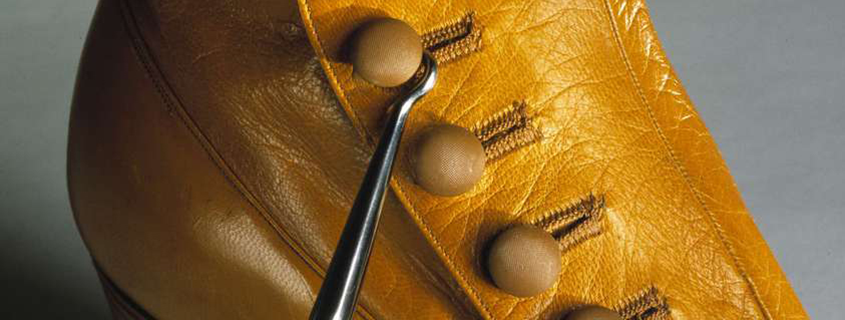
Hooks were made of various metals depending on their intended use. Hooks for boots typically had a steel shank for strength. Whereas for gloves, they could be smaller and made of other metals such as silver, gold, or brass. Handles were made of ivory, bone, silver, nickel-plated steel, pewter, wood, celluloid, or Bakelite. The first plastic button hook handles were made to mimic earlier materials like bone or ivory. If you look carefully at Grandma Susie’s hook, you can see the celluloid handle has striations reminiscent of bone or ivory handles that it emulates.

Button hooks could be decorative, and some were quite ornamental. Many were plain like Susie’s hook. Companies also gave them away as promotional items with the company name prominently displayed. Button hooks came in a variety of sizes and shapes. The main variation is in length and diameter of the hook, ranging in length from 1” to over 20”. However, hooks for shoes generally ranged from 7” to 12” and had a hook diameter of about 3/8ths-inch. They were small portable tools that could be carried around.

Suzie’s celluloid button hook is plain and undecorated. But it has special meaning to me because it is a connection to my grandmother as a young woman. You can see button hooks similar to Susie’s in SOULA’s Historic Plastics Digital Collection.

Celluloid button hook

Celluloid button hook with striations in the celluloid to mimic bone handles

Black and white photograph of two pairs of booted feet

Susie’s button up boots

Featured image is by Birgit Brånvall, CC BY 3.0 no, https://commons.wikimedia.org/w/index.php?curid=29476283


Julia Huddleson is an archaeologist at the California Department of Transportation. She specializes in Post-Contact Archaeology and is the co-creator of the Historic Plastics Workshop with Kimberly Wooten.